
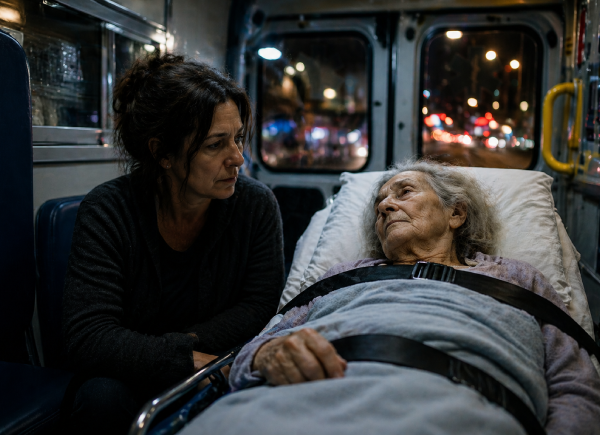
The ambulance bounced, shimmied and shook over the pitted and pothole ridden
streets of Coney Island, and the old woman strapped into the stretcher winced as her
frail body was jarred by the bumps. I hoped her bones weren’t so brittle that they could
be easily snapped. It hurts, she mumbled to no one.
When the ride smoothed out, she pursed her lips into a sneer of disapproval, a very
familiar look for me, and asked when’s someone going to fix this?
The once fabled wooden roller coaster, The Cyclone, grew smaller as we continued
down Surf Avenue, and my mother squinted her eyes, as if she was seeing me for the
first time, though we’d been riding for 40 minutes already.
My memory recalled the screams and ensuing shrieks, terror and laughter, from the
roller coaster as summertime riders experienced that first, precipitous drop, the fear and
dread building on the slow ascent, the release and feeling of flying as the coaster
swooped, slowed and sped up along the twists and turns, hills and valleys of rickety,
slippery tracks. I loved riding the coaster as a teen. The Adrenalin rush lasted a week.
After we’d driven a dozen blocks further away, Mom asked, “Where are we?”
“On the way to the rehab Mom. We’ll be there soon.”
This was the elder adult version of Are We There Yet, except Mom would not
remember the answer this time, or next. I grabbed the edge of my seat with both
hands as we hit a deep pothole, and Mom turned her head and looked at me with
rheumy green-grey eyes. But she didn’t see me- as they say, the lights were on but
nobody was home. She seemed to look through me, at something beyond our physical
confines. One withered hand with raised blue veins grasped the side of the stretcher as
she tried to turn her rail thin body toward me. Her body had lost its entirety of muscle
tone, she literally could not move one. One of her common, punitive admonishments
when we were little, was don’t move a muscle. Oh, the irony.
She had been wheelchair bound for a couple of years, declining steadily,
preferring to be sedentary rather than moving. She stopped using a walker and going
out regularly for short walks, and only went out for an occasional mani/pedi, haircut, or
family dinner. She made no effort to keep her body vital. She was a lifelong
hypochondriac, and whatever deficiency or ailment they discussed on Talk Radio, or Dr.
Phil that day, amazingly, she was afflicted with it.
While I lived with her after divorcing Sami, she woke me at least a dozen times a
year, in the middle of the night, to drive her to the hospital ER, because she was always
having a heart attack. There was never anything wrong with her, tests showed no
illness or ailments. Her heart was strong and regular, her blood pressure and other
vitals, always stable. indigestion was a usual scapegoat.
then, after she retired from work too early, she filled her days with visits to various
doctors offices, always seeking the source of phantom sickness. It was the same tactic
her mother had used- feign illness to get attention from the family, otherwise they were
prone to negligence. For me and my siblings, and our mother as the child of a
hypochondriac, these incidents became a case of crying wolf. We no longer trusted that
there was an actual medical problem when our mother announced she had one.
And she doubted her own 85 year old mother when she called at 3:09 a.m
demanding we come over, and bring an ambulance with us. 99% of the time there was
nothing physically wrong. It was in those wee hours that the terrors flooded back, the
pograms, and fires, and people burning, screaming and dying. The lifetime of trauma
weighed heavily on my grandmother’s heart, and sometimes, it crushed her.
Mom took too many prescription drugs, and nobody tested for drug interactions
then. She had a pill for everything, it was so easy to get prescriptions before opioids
became epidemic. She settled into a self medicating routine of vodka, Vicodin, and
Valium for several years, and when she quit booze, added more, other, different pills for
her menu of ailments. No wonder she had indigestion, all those pills were eating her
stomach lining. None of the pills softened her jagged edges, or tamed her vicious
tongue.
None of us, her middle aged children, had the required strength to lift 89 years,and 150 pounds of virtually dead weight, without risking hurting ourselves. We had no
training, or skills on how to care for an elder, infirm patient. My brother, the youngest,
was 54, and I was the oldest at 60. I’d had several accidents and injuries, living in NYC
is dangerous, and suffered from chronic sciatica, so lifting and schlepping was off the
table for me. It was all I could do most days to take care of my own body.
On special celebration days, her aide would get her bathed, groomed and
dressed for a car ride. The Aide du Jour did the heavy lifting, got her situated in, and
then out of a car. She also wrangled the wheelchair and made bathroom runs and
diaper changes at whatever location we were in.
It’s not like Mom appreciated it. I was anxious around her, because, without fail,
even though so many people had made a Herculean effort to include her, to show her
that she was loved, she bad mouthed everyone and everything, and appreciated
nothing. I had often experienced her as a spiteful, envious, jealous, mean spirited,
angry, negative 9 year old Brat, the age where her development was arrested.
Once at the party, she’d ensconce herself in a desired spot, among the relatives
and various in-laws. She gave running commentary on how shitty everyone looked.
She criticized the kid who’s birthday it was. She hated the cake, the other kids, the
noise, the parent people, the inconvenience of the 2 hour car ride. The coffee was too
weak. The space was too crowded.
She didn’t consider the unpleasantness everyone else experienced because she
wouldn’t just be quiet.
I knew all she wanted, longed for, was to spend time with the family. But she
sabotaged herself with the hurtful commentary, the total lack of gratitude, and overall
meanness that punctuated whatever she said
She continued her mental meandering as the vehicle bounced toward its final
destination in Coney Island. I know this is what I have to do. I know it’s what’s best for
me. But it’s scary. She repeated these words, a temporary mantra, to reassure herself.
I was surprised that she suddenly seemed so lucid and aware of why we were in a
medical transport vehicle en route to an assisted living facility. Some inner knowing
seeped to the surface, and some part of her understood the painful reality of her
situation.
I’m cold she croaked through a toothless mouth. I turned and asked the EMT
for a blanket. I wondered where her dentures were, if she had them in the hospital, or if
they were at her bedside at home. She hadn’t bothered to put in her teeth or hearing
aids the last few times I saw her, and I forgot what her face looked like with the
dentures to fill up the emptiness of her sunken mouth.
She didn’t look like her mother or father. She was a hybrid of both, and had been
a Loretta Young doppelgänger as a blossoming young woman, before hate had
poisoned, and Dorian Greyed her.
The EMT unstrapped his seatbelt and half stood as he reached up to a low
hanging metal shelf. He handed me a flimsy blanket, made of some high tech fiber that
was thin as a bed sheet. I unfolded it and draped it across my mother’s bony body. Her
eyes followed me. Lori? she asked, unsure if I was a vision, or her eldest daughter in
the flesh.
“Yep, still me Mom.”
Where are we? Where’s Bitsy? Beautiful baby, Bitsy. She loves the snow. Where
are you girl? Here Bitsy. She patted her stomach, calling for her childhood Pomeranian.
Lori? She asked again, trying to focus her eyes. What the hell is going on? So much
for lucidity.
“Almost there, just a few minutes more. We’re still en route to the rehab Mom.
You were discharged from the hospital a little while ago, and aren’t ready to go home
yet. You need some therapy to regain your strength.”
She’d been given quite a bit of medication during her week long stay in Coney
Island Hospital, and I didn’t know if her disorientation was drug induced or due to
progressing dementia. She had been admitted through the ER after falling, again, and
hitting her head, as well as sustaining some pretty bad bruises on her legs and arms.
The day before when I visited her, she told me that she wasn’t always sure if she was
awake, or when she was dreaming. She had delusions of being attacked, and in turn,
lashed out at doctors and nurses, even going so far as to bite one when he tried to help
her sit up in the hospital bed. As a result, they restrained her with a soft vest that bound
her arms to the sides of the bed. One of the nurses called the behavior sundowning,
and said it was common among dementia patients.
One of the social workers at the hospital persuaded us that a nursing home was the
next best step for Mom – she’d fallen three times in as many months trying to get out of
bed on her own, even with full time care to look after and assist her. She needed help to
eat, bathe and use the toilet. Her short term memory was shot, and she couldn’t
remember things she did or said just a few moments before. The only thing that still
worked perfectly was her fucking mouth.
Her behavior had become increasingly violent and erratic, and police had been
summoned to her apartment after several outbursts, including a few stabbing attempts
that caused her aide to call the cops. The agency who supplied the home attendants
threatened to withhold help if another act of violence jeopardized the safety of one of
their employees. we were on the fourth such agency already. Mom had rejected over30 home care workers, and the agencies were now firing us as pain in the ass clients.
Also a dangerous, abusive client.
My sister and I had spent several days combing the Medicaid friendly assisted living
homes and rehabs in Brooklyn. Joy insisted it be Brooklyn because the grandkids lived
there, and needed to be nearby for visits.
my mother relied on her monthly checks from Social Security for income, and could not
afford a luxurious place. We found several that we thought would be adequate, the
criteria being that the stench of piss didn’t hit you in the face when you walked inside,
and the residents looked clean and well cared for. The place was full, but we put our
mother’s name on a waiting list. When she was done with rehab, she could be
transferred.
Mom tried to prop herself up on bony elbows, but the muscles in her arms had atrophied
to the point that merely raising her arm required all her effort. She had no core strength,
and each time she was propped up in a sitting position, she slumped sideways within a
matter of minutes. Fuck, she exhaled.
I knew this was the beginning of the end of my mother’s life, and had begun a detached
mourning during the hospital visits. Mom and I had a contentious and difficult
relationship for my whole life, and nothing I said or did was ever enough, and certainly
never good. I’d given up on the relationship when she told me I couldn’t get married
and abandon her. Who the hell is going to take care of me?
“Well, Ma, you. You will have to take care of yourself. I am not your partner or
parent. It is not my job to sacrifice my life and happiness to take care of you. And,
because you seem to have not noticed, I have been taking care of you, all these years.
And now I have to live my own life. I’m a 45 year old woman. It’s time.”
Since then, I stayed away, seeing her only at holidays, weddings, funerals. As her
condition deteriorated, and she became very fussy about food, each week I sent her a
delivery of all her favorite things to eat from Fresh Direct, a local grocery delivery
service. One day my sister asked me if I knew that all the food was tossed in the trash.
I was shocked to learn this. Joy explained, “every week when the food comes, she calls
me and asks why you sent her all this crap she doesn’t want.” So I stopped.
The ambulance slowed and made a wide left turn into a driveway. Mom continued
talking to the air. I know this is best for me, but it’s such a big change. I’m scared.
There’s nothing for me at home anymore. I never go out. All my friends are gone. I have
no one to talk to. Except Fiona. Where’s Fiona? Fiona was her 15 year old cat – she
was badly neglected. Her lower lip started to tremble and she began to whimper, then
cry. I miss Papa. Her voice sounded like a child’s.
I edged closer to her without lifting my seat off the bench I’d been sitting on, and
wrapped her in my arms.
“I know Ma. It is a big change. It’s for the better though. You’ll have someone to watch
over you all the time. They won’t let you fall again. You’ll be safe and cared for by
people who are trained to do that. Everything will be OK. Maybe you’ll even make new
friends. You’re right on the boardwalk. Maybe the kids will bring the little ones to visit
and you can sit in the sunshine with them. It’s up to you whether your experience is
good or bad. This is necessary. For your own good.”
In the late 1980’s Mom had to put her own mother into a facility after she fell and broke
her hip, and lay alone in the apartment for three days before we found her. Mom had
turned a deaf ear to my grandmother’s pleas, and had shown little compassion to her
frightened shell of her mother. I wondered if she remebered any of that, the way my
grandmother, my Mama, had pleaded, stay just a little longer, please.
Where’s Fiona? She asked again.
I’d taken Fiona to stay with my vet, Wendy, the night before, after she thankfully agreed
to take in the poor old girl after she’d been left alone in Mom’s apartment for several
days following the fall and subsequent hospital stay. Her coat was matted into old age
dreadlocks, and her eyes were filmy, black, she was blind. Her breath reeked. She
had a large tumor in one ear that had been unchecked.
When Joy and I had first opened the door to Mom’s apartment to fetch some things for
her, a wall of stench – decay, urine soaked clothes and bedsheets, feces and assorted
other nasty smells – assaulted my nostrils and made me gag. I didn’t know if the odors
were animal, human, or a combination of both, and I held my breath as I entered the
living room, and headed straight to open the windows and terrace door to get some
fresh air into my mother’s hermetically sealed home.
I looked around my adolescent home, where I’d moved in at 12 and left at 21, then
returned to for a stint at 30 until 45. The home that had given me pride as an adult
woman, a home where I’d replaced the remnants of an old life- one that held broken
furniture, cracked old floor tiles and dingy walls, broken hearts and dreams.
We scraped and primed walls, and covered them with softly colored wallpaper. We
bought new couches, and furniture, and added custom built-ins for Mom and me in our
respective bedrooms. I’d cooked family dinners for all of us on Sundays, and reveled in
sleepovers with my nephews and nieces when they were children. I’d left for the last
time in 1997, and wondered when and how everything became so squalid in the
ensuing years.
My mother had once been obsessively clean and neat, like her mother, whom I
remember most for reeking of bleach, on her hands and knees scrubbing imaginary dirt
from floors and walls for most of her waking hours. Every weekend of my teen years
had been spent dusting, vacuuming, polishing, scouring and scrubbing, doing laundry
for the whole family of 5, cleaning the bathtubs, toilets, ovens, all under my mother’s
watchful eye and foot tapping, whip cracking, micro managing direction. she hovered
over me, don’t do it that way, do it this way. Do it again.
Now, in this decrepitude, opened boxes and bags of snack foods, half filled cellophane
sleeves of cookies, stale and dry boxed cakes, crumbs and other schmutz, littered the
dining table and spilled onto the chairs. Dust coated the chachkes in a wall mounted
curio cabinet, and the wallpaper in the dining room had started to peel at the seams. An
ornate clock that once chimed the hour, hung forlornly on a wall that time forgot. Some
of the corners of the green, faux marble vinyl tiles in the kitchen also peeled away from
the floor, and the beige, once thick, high pile carpet was threadbare in many places
throughout the 6 room apartment with the ocean view.
Fiona’s stainless steel water bowl was coated with biofilm, that slimy, gluelike bacterial
substance that adheres to surfaces in watery environments, like dental plaque. Dust
and cat hair floated on top. Her ceramic food bowl was encrusted with dried up wet
food, and appeared to have not been properly washed in eons. The women who came
to care for Mom had their hands full with the old lady, and none of them really cared for
the poor scraggly cat.
I bent down and picked up all the bowls and placed them in the sink, then squirted some
soap into them and let hot tap water run over them. I opened a squeaky, rusty drawer,
off its track, in a rusty, once white aluminum cabinet, and plucked a packet of Starkist
tuna from its depth. I fumbled through drawers looking for a scissor, and found one with
rusty blades, the tips broken off, and emptied the tuna into a clean “people” dish taken
from an overhead cabinet. Didn’t much matter anymore whether it was a cat dish or
people dish – odds were that Mom wouldn’t return to this place. Fiona’s nostrils caught
a whiff of the tuna, and she lapped at the juice and hungrily dug into the food.
I walked through a narrow hallway to the windowless half bathroom where Fiona’s litter
box was kept under the sink next to the toilet. The box was devoid of cat litter, full of
turds, some dry as raisins, and some that stuck to the bottom of the plastic box. A few
clumps of pee remained from when there had been ample litter, but I had no way of
knowing when that was. The smell of ammonia was unbearably overpowering, which I
knew meant that Fiona was dehydrated. I was so relieved that Wendy agreed to look
after, and try to find her a home.
I went back to the kitchen and rifled through drawers and cabinets looking for a plastic
trash bag large enough to hold the entire litter box – there was no way in hell I was
about to start scrubbing that filthy thing, and found nothing but empty boxes of Hefty
trash bags, and Ziplock quart and sandwich sized plastic baggies. I opened a hallway
closet and found bags filled with bags, and looked for one big enough to hold the litter
box. I found an old Duane Reade shopping bag and put the shit filled box in it, then
took it to the incinerator room. When I came back into the apartment, I opened windows
in every room and welcomed the cool, fresh, winter air.
On that night, I began to mourn the loss of my mother, and was determined to bury the
past and move forward. Besides the end of this era, I was also in the end stages of
divorcing Alan. At 60, I would begin a whole new life as a single woman.
I found Fiona’s carrier, and made it ready for her trip to Wendy. She had puked in the
car on the way into the city, and I had to give the car driver an extra 50 bucks for the
mess. But this was one less mom problem to deal with now, and for that I was grateful.
Also that the poor neglected cat would finally get the care she so obviously needed.
And I needed some sleep before returning to Brooklyn the next day. There would be a
lot of hurry up and wait at the hospital, while the discharge orders were carried out, and
transport could be arranged. Nothing happened easily or quickly in the monolithic
bureaucracy of the so called health and hospital system.
The EMT’s opened the back of the ambulette, and busied themselves preparing to
move my mother into the facility. Every sound or movement elicited an OOF from her.
Soon we were inside the building, where the EMT’s transferred her to a wheelchair fro
the stretcher, and away they went. An administrator greeted us, and told us about
forms that needed to be filled out, and other non medical information needed. they
were waiting for the hospital to transfer their notes and records.
Mom hated the place from the get go. She was suspicious, wary, vocal. She’d already
decided this was not for her. She locked down her mind, and all her prior recitations of
“I know this is best for me”, became an anomalous blip. It took a few hours to get her
situated in her room, a semi private, that she shared with another old woman. Each one
had their own little space, with a shared bathroom. Joy placed photos of her kids
around the room, and we called housekeeping to connect the television. I called an
Uber and decided to go home for the night. There was nothing more for us to do, or so I
thought.
I could not have foreseen the storm that was coming, and the damage it would cause to
our family for years to come.